Call us (786) 7096307

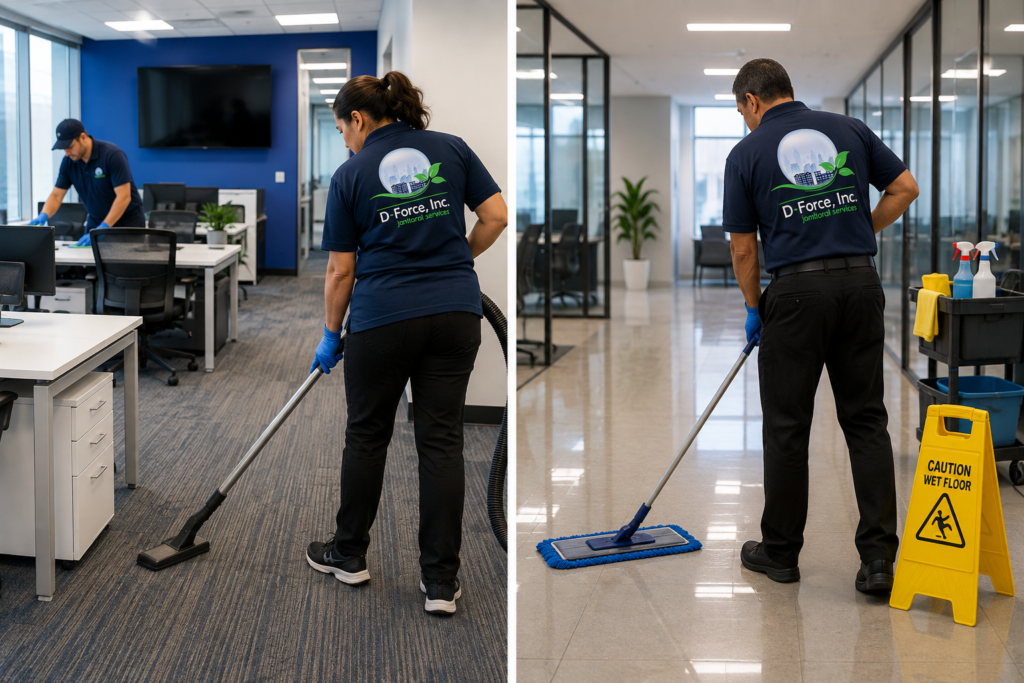
A commercial building should not be cleaned as if every area receives the same amount of use.
A private office occupied by one employee and a lobby crossed by hundreds of people every day clearly have different cleaning needs. Yet many commercial cleaning programs still apply similar frequencies throughout the entire property.
For business owners, property managers, and facility managers, this can create an important problem: cleaning resources are being distributed according to square footage instead of actual building traffic.
High-traffic areas require a different strategy.
Entrances, lobbies, elevators, restrooms, main hallways, breakrooms, and other frequently used spaces can change significantly throughout the business day. A cleaning schedule that looks appropriate at 8:00 AM may no longer be sufficient by lunchtime.
An effective commercial cleaning program should therefore consider not only what needs to be cleaned, but also how frequently each area is used and when that usage occurs.
What Is a High-Traffic Area?
A high-traffic area is any part of a commercial property that experiences frequent use by employees, tenants, customers, vendors, or visitors.
Common examples include:
Main entrances
Lobbies and reception areas
Elevators
Restrooms
Main hallways
Stairways
Breakrooms and kitchens
Waiting areas
Conference rooms
Shared workspaces
However, high traffic is relative.
A conference room used once per week may be a low-traffic area in one office. In another facility, the same type of room may host meetings continuously throughout the day.
That is why cleaning frequency should be based on how the individual property operates, rather than assumptions about the type of room.
Start by Dividing Your Building Into Traffic Zones
One practical way to develop a better cleaning strategy is to divide the facility into three categories:
| Traffic Level | Examples | Cleaning Approach |
|---|---|---|
| High Traffic | Entrances, lobbies, restrooms, elevators | Frequent attention and inspections |
| Medium Traffic | Conference rooms, breakrooms, main offices | Regular scheduled cleaning |
| Lower Traffic | Storage rooms, limited-use offices | Rotational or less frequent service |
This simple classification can help property managers determine where cleaning labor should be concentrated.
The objective is not necessarily to clean the entire building more often.
It is to clean the right areas more often.
Entrances Need More Than Nightly Cleaning
Your building entrance is one of the first areas visitors see.
It is also one of the areas most exposed to exterior dirt, moisture, debris, fingerprints, and constant foot traffic.
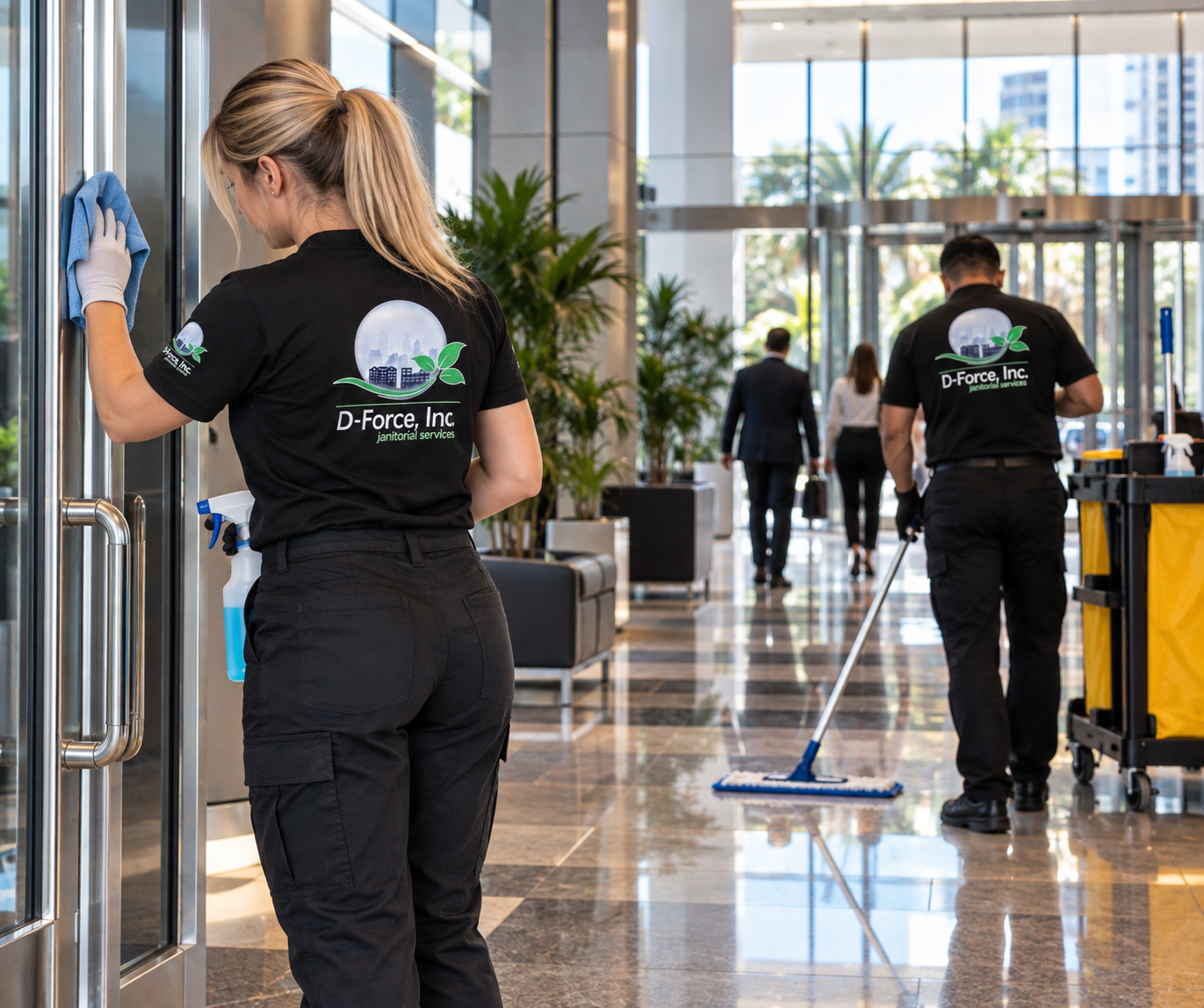
A nighttime cleaning crew may leave an entrance in excellent condition. But once the building opens, hundreds of people can pass through the same area.
By the afternoon, glass doors may have fingerprints, entrance mats may contain debris, and floors may no longer look the way they did in the morning.
For high-traffic commercial properties, entrance maintenance may require both nighttime cleaning and daytime attention.
A day porter can help monitor the entrance, spot-clean glass, address visible debris, and maintain the appearance of the area throughout business hours.
Restroom Frequency Should Follow Usage
Restrooms are one of the clearest examples of why traffic should determine cleaning frequency.
Consider two commercial restrooms.
One is used by 15 employees.
Another is located in a multi-tenant commercial building and receives hundreds of visits throughout the day.
Should they have exactly the same cleaning schedule?
Probably not.
High-traffic restrooms may require scheduled inspections throughout operating hours to check:
Paper Supplies → Soap → Trash → Sinks → Fixtures → Floors → Overall Condition
Detailed restroom cleaning can still take place at night, while daytime service focuses on maintaining acceptable conditions between deeper cleanings.
The goal is not to wait for a complaint before discovering that a restroom needs attention.
Elevators Require a Different Strategy
Elevators concentrate a surprising amount of traffic into a very small area.
Buttons are constantly touched. Stainless-steel surfaces collect fingerprints. Floors receive continuous foot traffic.
In a multi-story commercial building, elevators may be among the most frequently used areas of the entire property.
For this reason, elevator cleaning should often include both routine detailed cleaning and visual checks during the day.
The exact frequency depends on building occupancy and usage.
High-Traffic Floors Need Preventive Maintenance
Floor maintenance is another area where traffic makes a major difference.
The floor near a main entrance experiences conditions that floors inside private offices may never encounter.
Dirt and debris can gradually move from the entrance into hallways, elevators, and other common areas.
Routine vacuuming, sweeping, and mopping are important, but high-traffic flooring may also require periodic professional maintenance.
Depending on the flooring material and condition, this can include:
Machine scrubbing
Buffing
Polishing
Carpet cleaning
Spot treatment
Stripping and waxing where appropriate
Periodic deep cleaning
The important point is to schedule floor care before excessive wear and buildup become obvious problems.
Preventive floor maintenance can be more effective than waiting until floors require major corrective work.
Breakrooms Can Become High-Traffic Areas Quickly
Breakrooms and office kitchens may appear relatively clean early in the morning.
Then employees begin making coffee, preparing meals, using microwaves, filling trash containers, and using countertops, sinks, and tables.
The busiest period may occur around lunch.
If the cleaning program only addresses the area once every evening, management may find that the breakroom looks poorly maintained during the period when employees use it most.
Depending on the size of the facility, a daytime inspection can help maintain these areas between nighttime cleanings.
High-Touch Surfaces Also Follow Traffic
Traffic does not only affect floors.
The more people use a particular area, the more frequently certain surfaces are touched.
Examples can include:
Door handles
Elevator buttons
Handrails
Common-area counters
Shared appliance handles
Frequently used doors
Instead of treating every surface throughout the property identically, cleaning frequencies can prioritize surfaces in the busiest shared areas.
This is another example of how a traffic-based strategy can focus cleaning resources where they are most useful.
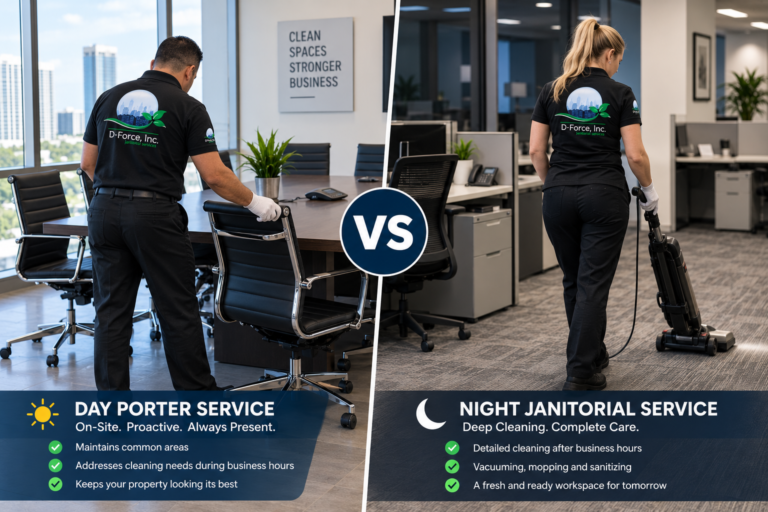
Day Porter vs. Night Cleaning in High-Traffic Buildings
For some facilities, nightly janitorial cleaning is enough.
For others, it is only half of the solution.
A high-traffic building may benefit from dividing cleaning responsibilities between daytime and nighttime service.
The strategy can look like this:
NIGHT → CLEAN & RESET
Detailed cleaning takes place while the property is less occupied.
MORNING → INSPECT
Critical areas are checked as the building begins operating.
DAY → MONITOR & MAINTAIN
A day porter addresses changing conditions in restrooms, entrances, elevators, common areas, and other priority locations.
NIGHT → CLEAN & RESET AGAIN
The nighttime janitorial team prepares the property for the following business day.
This creates continuity instead of relying on one cleaning visit to maintain the building for the next 24 hours.
Avoid the “Everything Every Day” Approach
There is an important distinction here.
A traffic-based cleaning strategy does not mean every part of the building should receive more cleaning.
In fact, that can waste labor and increase costs unnecessarily.
Instead, the cleaning plan should identify which areas deserve additional attention and which can remain on a standard or rotational schedule.
For example:
Entrance: High Frequency
Restrooms: High Frequency
Elevators: High Frequency
Main Hallways: Daily
Conference Rooms: Based on Use
Private Offices: Scheduled
Storage Areas: Rotational
This allows the janitorial program to allocate time more efficiently.
Watch for Peak Traffic Times
Cleaning frequency is only part of the equation.
Timing also matters.
A lobby may experience its heaviest traffic between 8:00 and 10:00 AM.
A breakroom may become busiest between noon and 2:00 PM.
Restrooms may experience predictable periods of increased usage.
Understanding these patterns allows a facility manager to schedule inspections more strategically.
Instead of checking every area at arbitrary times, janitorial resources can be directed toward predictable periods of demand.
Your Cleaning Strategy Should Change When Traffic Changes
Commercial buildings are not static.
A new tenant may move into the property.
A business may hire additional employees.
Operating hours may increase.
A previously quiet floor may become occupied.
Visitor traffic may change.
If traffic changes but the cleaning schedule does not, service quality can gradually decline.
Property managers should periodically review their cleaning program and ask:
Which areas are receiving more traffic than before?
Where are most cleaning complaints occurring?
Which trash containers fill fastest?
Which restrooms require the most attention?
Which floors show wear first?
At what time of day do problems usually appear?
These questions provide useful information for adjusting the janitorial schedule.
High-Traffic Cleaning Should Be Preventive, Not Reactive
A common mistake is waiting until a problem becomes visible before addressing it.
The trash overflows—then someone empties it.
The restroom runs out of paper—then supplies are replenished.
The lobby floor becomes noticeably dirty—then it receives additional cleaning.
That is reactive cleaning.
A better strategy identifies predictable conditions and creates cleaning frequencies designed to address them before they become recurring complaints.
The objective should be:
Traffic → Identify Need → Establish Frequency → Inspect → Adjust
This transforms commercial cleaning from a series of reactions into a more structured maintenance program.
Better Cleaning Does Not Always Mean More Cleaning
For business owners and property managers concerned about janitorial costs, this distinction is important.
A customized high-traffic cleaning strategy does not automatically mean increasing total cleaning hours.
Sometimes it means redistributing them.
Perhaps a low-use office does not need the same frequency currently assigned to it.
That time could instead be used to inspect a high-traffic restroom or maintain the main entrance.
The question should not simply be:
“How many hours of cleaning are we buying?”
A more useful question is:
“Where are those cleaning hours creating the most value for our property?”
Professional Commercial Cleaning for High-Traffic Buildings in Miami
At D-Force Janitorial, we understand that high-traffic commercial properties require more than a generic cleaning checklist.
The appropriate cleaning program should consider how employees, tenants, customers, and visitors actually move through the facility.
That means evaluating entrances, restrooms, elevators, common areas, breakrooms, flooring, operating hours, and peak traffic periods before establishing cleaning frequencies.
Depending on the property, a customized program can include commercial cleaning, office cleaning, nightly janitorial services, day porter services, restroom maintenance, common-area cleaning, and professional floor care.
The goal is not to clean every area more frequently.
It is to provide the right level of cleaning in the right area at the right time.
Is Your Cleaning Schedule Keeping Up With Your Building Traffic?
If your property looks excellent first thing in the morning but begins showing cleaning problems only a few hours later, your cleaning company may not necessarily be doing a poor job.
Your building may have outgrown its current cleaning schedule.
A high-traffic facility needs a janitorial program that recognizes where traffic occurs, when it occurs, and how quickly different areas require additional attention.
For business owners, property managers, and facility managers, understanding those patterns can lead to a cleaning program that is more consistent, efficient, and easier to manage.
Looking for professional janitorial services for a high-traffic commercial property in Miami? Contact D-Force Janitorial for a free estimate. We can evaluate your facility, identify its highest-traffic areas, and develop a customized commercial cleaning plan based on the way your building actually operates.
Call us now: (786)7096307