Call us (786) 7096307


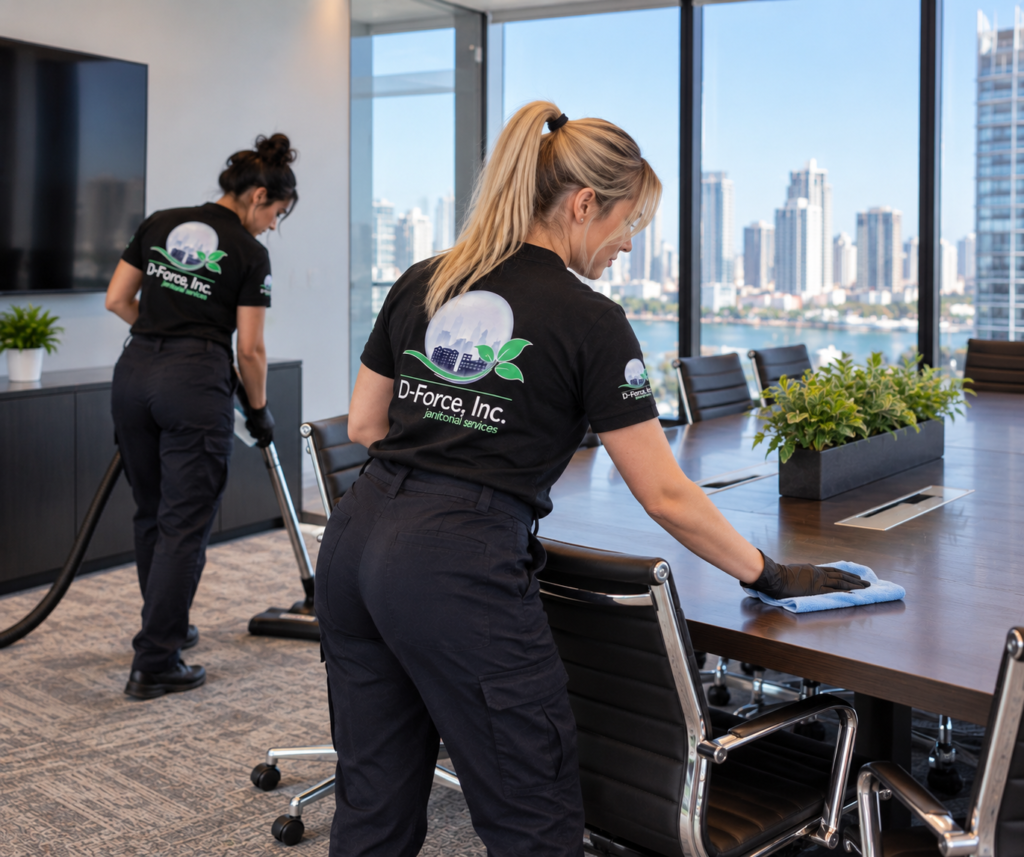
When business owners and property managers evaluate commercial cleaning services, they often focus on what will be cleaned.
Will the company vacuum the offices? Clean the restrooms? Mop the floors? Remove the trash? Maintain the breakroom?
Those questions are important, but there is another question that can have an even greater impact on the condition of a commercial property:
How often should each area be cleaned?
Cleaning frequency is one of the most important—and sometimes overlooked—parts of a professional janitorial program.
A cleaning company can have a detailed checklist and still struggle to maintain a property if tasks are performed at the wrong frequency. On the other hand, cleaning every area every day can be unnecessary and inefficient.
The goal is to determine the right frequency for each area based on traffic, usage, operating hours, and the specific needs of the facility.
Cleaning Frequency Should Not Be the Same Everywhere
Consider two areas inside the same commercial building.
The first is a private office used by one employee.
The second is a main restroom used by employees, tenants, customers, and visitors throughout the day.
Both spaces need professional cleaning, but they probably do not require the same frequency.
The same principle applies throughout a commercial facility.
Entrances, lobbies, elevators, restrooms, main hallways, and breakrooms often require more frequent attention because they experience greater daily use.
Private offices, storage areas, and limited-use rooms may require less frequent service.
A well-designed janitorial program recognizes these differences.
Instead of asking:
“How often should we clean the building?”
A better question is:
“How often should we clean each part of the building?”
Daily Cleaning Is Important—but Not Everything Needs It
Many commercial properties require daily or nightly janitorial service.
However, that does not mean every cleaning task needs to be completed every day.
Daily responsibilities may include:
- Restroom cleaning
- Trash and recycling removal
- Vacuuming high-traffic areas
- Sweeping and mopping
- Breakroom cleaning
- Entrance maintenance
- Elevator cleaning
- High-touch surface cleaning
Other tasks can be scheduled weekly, biweekly, monthly, or periodically.
These might include detailed baseboard cleaning, high dusting, interior glass cleaning, carpet cleaning, floor polishing, or other deeper maintenance services.
This creates a more efficient system:
Daily → Maintain
Weekly → Detail
Monthly/Periodic → Protect & Restore
The exact schedule should depend on the property.
Restrooms Are a Perfect Example
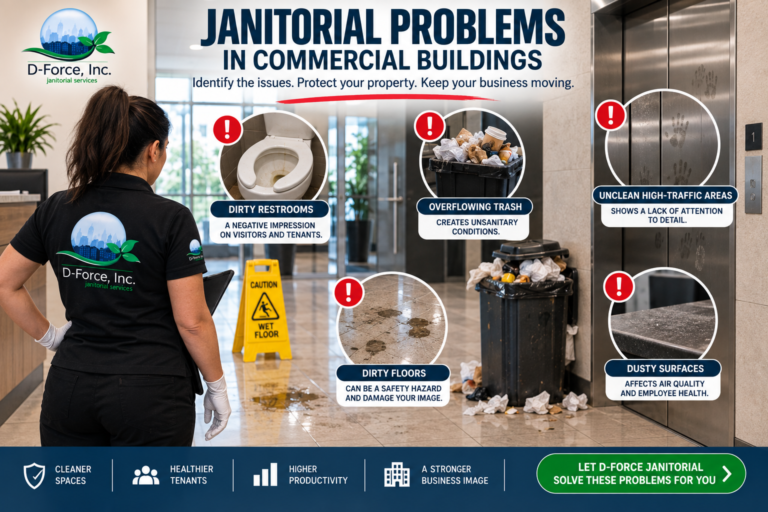
Commercial restrooms demonstrate why frequency matters so much.
Imagine that the restroom is professionally cleaned every evening.
At 8:00 AM, it looks excellent.
By noon, however, it has already experienced significant traffic.
Paper supplies may be getting low. Trash containers may need attention. Water may be visible around sinks. Floors may require spot cleaning.
Does that mean the nighttime cleaning crew did a poor job?
Not necessarily.
It may simply mean that one cleaning per day is not enough for that particular restroom.
High-traffic facilities may need a combination of detailed nighttime cleaning and scheduled daytime restroom inspections.
The correct frequency should follow usage.
Trash Removal Should Follow Volume
Trash is another simple example.
Some office trash containers may never become full during a single business day.
A busy breakroom trash container might fill much faster.
If both locations are serviced at exactly the same frequency, one may be receiving unnecessary attention while the other consistently develops problems.
Instead of treating all trash equally, a customized janitorial program can identify high-volume locations and adjust collection frequency accordingly.
This is a small operational change that can make the overall cleaning program more effective.
Floor Maintenance Depends Heavily on Frequency
Commercial flooring is one of the largest surfaces in a building and one of the first things visitors notice.
It is also constantly exposed to foot traffic.
Routine floor maintenance may involve vacuuming, sweeping, and mopping, but periodic professional services can also be necessary depending on the flooring material.
These may include:
- Carpet cleaning
- Machine scrubbing
- Buffing
- Polishing
- Stripping and waxing
- Periodic deep cleaning
Waiting too long between services can allow dirt and buildup to become more difficult to address.
At the same time, performing specialized floor maintenance more frequently than necessary can increase costs without providing meaningful additional value.
The correct frequency should consider flooring type, traffic, condition, and facility requirements.
Cleaning Too Little Creates Problems
When cleaning frequencies are insufficient, the results are usually visible.
Restrooms deteriorate between services.
Trash accumulates.
Floors lose their appearance.
Breakrooms become difficult to maintain.
High-touch and highly visible surfaces are neglected.
Property managers begin receiving complaints.
Eventually, the janitorial program becomes reactive.
Instead of following a planned schedule, the cleaning company spends more time responding to problems after they occur.
That is inefficient for both the cleaning provider and property management.
But Cleaning Too Frequently Can Also Be Inefficient
This is the other side of the equation.
More cleaning is not automatically better.
If a low-traffic conference room receives the same attention as a heavily used lobby, cleaning labor may not be allocated efficiently.
A storage room may not require daily service.
A private office occupied only a few days per week may need a different schedule than a shared workspace.
The objective should not be to maximize the number of cleaning tasks.
It should be to match cleaning frequency to actual need.
For business owners and property managers, this can help control janitorial costs without automatically reducing standards.
Your Building’s Traffic Should Help Determine the Schedule
Foot traffic is one of the most useful factors when establishing cleaning frequencies.
A commercial facility can be divided into basic traffic categories:
| Area Type | Examples | Typical Strategy |
|---|---|---|
| High Traffic | Restrooms, entrances, elevators, lobbies | Frequent cleaning or inspections |
| Medium Traffic | Breakrooms, conference rooms, shared offices | Regular scheduled cleaning |
| Lower Traffic | Storage areas, limited-use offices | Rotational cleaning |
These are not fixed rules.
A conference room could become a high-traffic area in a busy organization, while another facility might rarely use one.
That is why the cleaning company should understand how your particular building operates.
Frequency and Timing Should Work Together
How often something is cleaned matters.
But when it is cleaned can matter just as much.
Suppose a busy breakroom receives its highest traffic between noon and 2:00 PM.
Cleaning it at 10:00 AM and then waiting until the nighttime crew arrives may not provide the best coverage.
The same applies to entrances, elevators, and restrooms.
Property managers should identify predictable peak periods and determine whether cleaning or inspections should occur before, during, or after those periods.
A good cleaning schedule considers both frequency and timing.
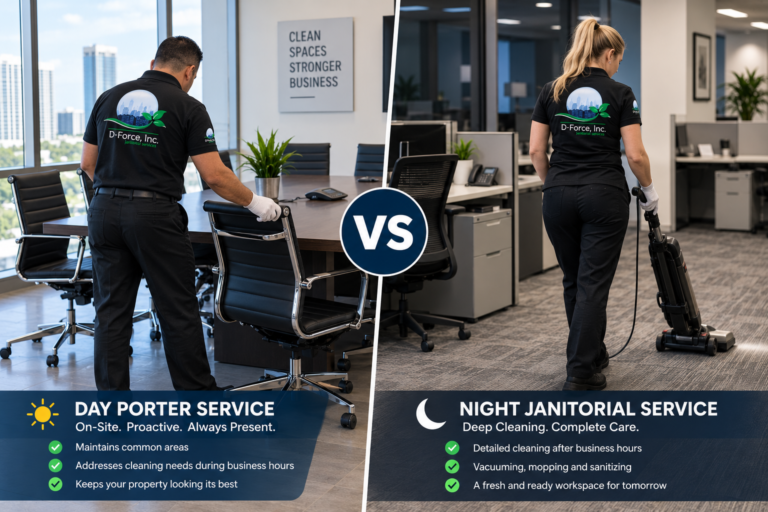
Day Porter Service Can Fill the Gap
For high-traffic commercial properties, nighttime cleaning may provide an excellent reset but still leave a long period during the business day without janitorial attention.
This is where day porter service can become valuable.
A day porter can monitor priority areas while the property is occupied, including:
- Restrooms
- Entrances
- Elevators
- Lobbies
- Breakrooms
- Common areas
- Trash
- Unexpected spills or cleaning needs
The nighttime janitorial crew can then perform the more detailed cleaning after business hours.
The two services can work together:
Night Cleaning → Clean & Reset
Day Porter → Inspect & Maintain
This approach can be particularly effective for commercial buildings with significant daily traffic.
Cleaning Frequency Should Change When Your Building Changes
One of the biggest mistakes in commercial cleaning is creating a schedule once and never reviewing it.
Buildings change.
A new tenant moves in.
More employees begin working from the office.
Operating hours expand.
Visitor traffic increases.
A previously unused area becomes active.
If the building changes but the janitorial schedule remains exactly the same, problems can gradually appear.
For this reason, property managers and facility managers should periodically review the cleaning program.
Ask:
Are certain areas receiving more traffic than before?
Where are complaints occurring most often?
Which restrooms require the most attention?
Which trash containers fill first?
Are some areas being cleaned more frequently than necessary?
The answers can help determine whether frequencies should be adjusted.
Recurring Complaints May Be a Frequency Problem
This is an important distinction.
If the same area repeatedly creates complaints, the immediate reaction may be to assume the cleaning employee is not performing correctly.
Sometimes that is the problem.
But not always.
Imagine a restroom that is properly cleaned every evening but repeatedly looks poor by 3:00 PM.
Cleaning it more thoroughly at 10:00 PM may not solve the problem.
The better solution might be adding a daytime inspection.
Whenever the same cleaning complaint repeatedly returns, management should ask:
Is this a quality problem—or a frequency problem?
That question can lead to a much better solution.
The Best Janitorial Schedule Is Not Necessarily the Biggest
A professional commercial cleaning program should not be measured by how many tasks are listed on the proposal.
A very long checklist can look impressive.
But if the frequencies do not reflect how the building is actually used, the program may still produce inconsistent results.
A more effective strategy prioritizes:
Right Task + Right Area + Right Frequency + Right Time
That combination is what helps create consistency.
A Customized Cleaning Schedule Can Improve Efficiency
For business owners, property managers, and facility managers, customized cleaning frequencies can help create a more efficient use of the janitorial budget.
Instead of distributing cleaning time equally throughout the property, labor can be concentrated where it provides the greatest value.
High-traffic areas receive more attention.
Medium-traffic areas follow regular schedules.
Lower-traffic areas can be placed on appropriate rotations.
Periodic services are planned in advance.
And when conditions change, the schedule can be adjusted.
This is a more strategic approach than simply increasing or decreasing total cleaning hours.
Professional Janitorial Services in Miami
At D-Force Janitorial, we believe a commercial cleaning schedule should be based on the actual needs of the property.
Every building has different operating hours, traffic patterns, restrooms, flooring, common areas, and cleaning priorities.
That is why our approach focuses on understanding the facility before establishing the appropriate cleaning program.
Depending on the property, services can include commercial cleaning, office cleaning, nightly janitorial services, day porter services, restroom maintenance, common-area cleaning, and professional floor care.
The objective is straightforward:
Clean what needs to be cleaned, at the frequency it actually needs to be cleaned.
Is Your Current Cleaning Frequency Right for Your Building?
If your commercial property looks clean immediately after service but develops the same problems before the next cleaning visit, your facility may not necessarily need a different cleaning company.
It may need a different cleaning frequency.
The right janitorial program should adapt to traffic, usage, operating hours, and changing building conditions.
For property managers and business owners, that can mean fewer recurring problems, better use of cleaning resources, and less time spent managing cleaning complaints.
Looking for professional commercial cleaning and janitorial services in Miami? Contact D-Force Janitorial for a free estimate. We can evaluate your facility, identify the appropriate cleaning frequencies for different areas, and develop a customized janitorial plan based on how your commercial property actually operates.
Call us now: (786)7096307